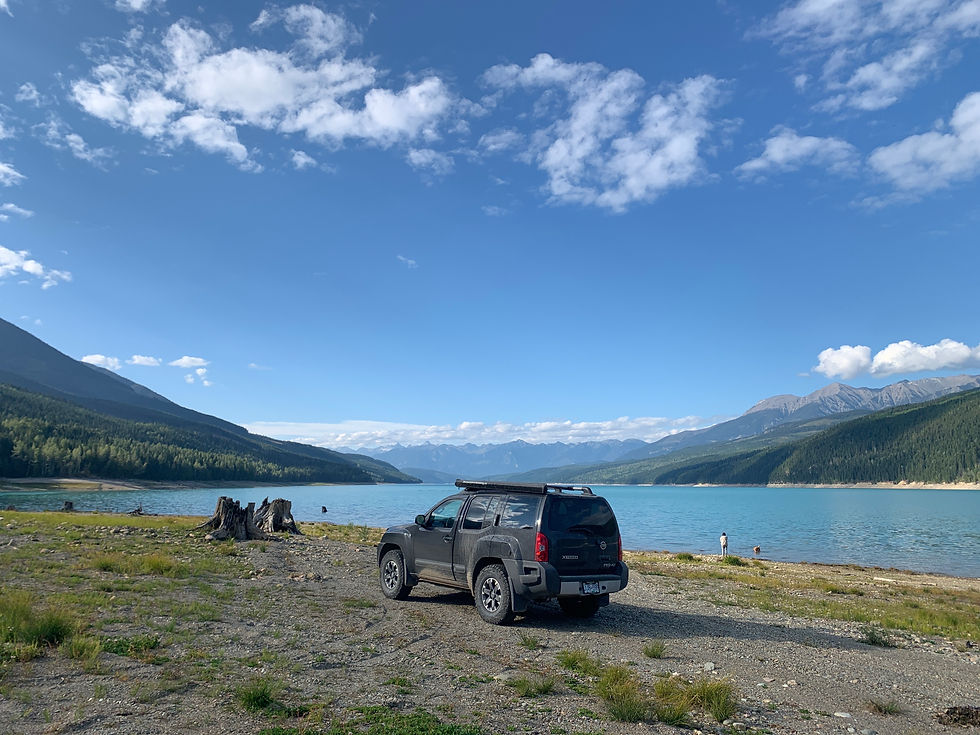
AWD vs 4x4 for Overlanding in British Columbia
One of the most common questions in overlanding is whether you need a 4x4.
The short answer? No.
Many of the routes featured on Untrammelled Travels can be completed in a capable AWD vehicle under the right circumstances. However, there are situations where a true 4x4 becomes more than just a nice-to-have.
The key is understanding the relationship between vehicle capability, terrain, and driver judgment. With the right route selection and a thoughtful approach, an AWD vehicle can be surprisingly capable on British Columbia's backroads.

What Matters More Than AWD or 4x4?
Before comparing drivetrains, it's worth mentioning that there are several factors that often matter more:
Ground clearance
Tire selection
Road conditions
Driver experience
Weather
A stock SUV with good tires and decent clearance will often outperform a more capable drivetrain running inappropriate tires. We've always run BFGoodrich All-Terrain tires, starting with the KO2 and more recently the KO3. While there are countless opinions on the "best" overland tire, we've found the BFGoodrich lineup to offer a dependable balance of durability, traction, and on-road comfort for the types of routes we typically explore throughout British Columbia.
Likewise, a route that is easy in August may become challenging after heavy rain or spring runoff.

When AWD Is More Than Enough
Many forest service roads in British Columbia are well-maintained gravel roads designed to support logging and resource access.
For routes like:
an AWD vehicle is often sufficient during normal summer conditions.
These routes generally involve:
Graded gravel roads
Moderate inclines
Limited technical obstacles
Minimal wheel articulation
In these situations, ground clearance is often more important than having low range.
If you're looking for routes suitable for newer overlanders or stock vehicles, check out our guide to Top Beginner Overland Routes in British Columbia.

When a 4x4 Starts to Make Sense
As routes become steeper, rougher, and more remote, the advantages of a 4x4 become increasingly apparent.
Examples include:
These routes may include:
Steep climbs
Loose rock
Deep ruts
Mud
Water bars
Uneven terrain
A 4x4 with low range provides greater control, particularly on steep ascents and descents where maintaining traction becomes more difficult.
The goal isn't necessarily to get through impossible terrain. It's often about reducing stress on both the vehicle and driver.
Looking for routes that push both vehicle and driver a little further? Explore our list of Challenging Overland Routes in British Columbia.

The Importance of Ground Clearance
If there is one specification that is consistently overlooked, it's ground clearance.
Many routes become inaccessible not because traction is lacking, but because:
Water bars are too deep
Rocks contact underbody components
Ruts become too severe
A vehicle with adequate clearance and good tires will often travel further than a low-clearance vehicle equipped with a sophisticated AWD system.

British Columbia Conditions Change Everything
One reason there is no universal answer is that conditions can change dramatically.
A route that is easily driven by an AWD vehicle in late summer may require a high-clearance 4x4 after:
Heavy rain
Spring runoff
Early snowfall
Seasonal washouts
Road conditions should always be assessed based on current reports rather than historical descriptions.

Choosing the Right Vehicle for Your Goals
If your goal is to explore scenic forest service roads, camp beside lakes, and access many of British Columbia's most rewarding destinations, a capable AWD vehicle is often all you need.
If your interests lean toward:
Remote alpine routes
Steeper mountain access roads
Technical terrain
Multi-day exploration
then a 4x4 becomes a worthwhile investment.
Planning longer journeys? These are some of our favourite Multi-Day Overland Routes in Western Canada.
The Bottom Line
Most people need less vehicle than they think and more preparation than they realize.
The best approach is to start with routes that match your current vehicle and experience level. As your confidence grows, you'll quickly learn where your vehicle excels and where its limitations begin to appear.
The goal of overlanding isn't to conquer every road. It's to safely reach places that most people never see.
And in British Columbia, there are plenty of those places accessible to both AWD and 4x4 vehicles.